What we build next
From a hackathon demo to a network you can take to court
Today two hand-wired boards prove the idea. To make it real, the trust has to come from the hardware, the judging has to be fair to honest operators, and someone has to pay for the data. We are learning from WeatherXM, which already does this for weather.

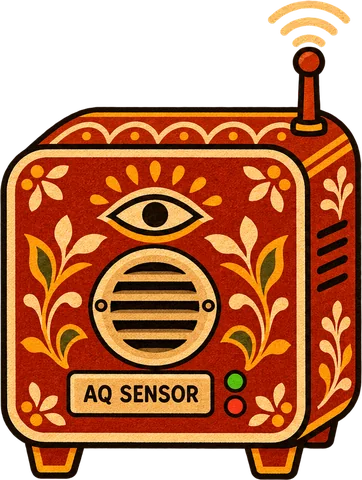
Phase 1 hardware
PranaNet Station v1
Target: under ₹10,000 retail. The ₹1,000 DIY node stays as a labelled community tier.
- Laser PM sensorreal PM1 / PM2.5 / PM10 instead of the hackathon's dust proxy (SPS30 / SEN5x class)
- Secure elementthe signing key is born inside the chip and never leaves it; factory attestation, so only genuine stations can register
- GNSS + Proof of Locationa signed daily location; moving a station resets its score, WeatherXM-style
- Tamper and health sensinglid switch, accelerometer, fan and flow checks: a blocked inlet or a moved box shows up in the signed data
- Secure boot and signed OTAreadings carry the firmware hash, so unofficial firmware is visible
- Wi-Fi + LoRaWAN / LTE-M, store-and-forwardoutages give late readings, not missing ones; solar kit for sites
- Calibrated per unitco-located with a reference monitor; the certificate lives on Arkiv, linked from the ENS name
- 1
PranaNet Station v1
months 0–4- Purpose-built hardware (left)
- 20 stations co-located at a reference site through monsoon and winter
- Every one of the five tricks caught by the hardware itself
- 2
A fairer, harder protocol
in parallel- Quality-of-Data score instead of a yes/no flag; rewards weighted by quality, location and coverage
- Warnings and a review window before any slash: honest faults never cost stake
- Judge only with enough real neighbours from different operators; no simulated nodes
- Several verifiers and relayers; one Merkle root per cell per minute on an L2; audits and a bug bounty
- 3
The product people pay for
months 4–9- Construction-site compliance kit for Mumbai: stations, dashboard, signed monthly reports
- Audit portal for regulators; API for apps, researchers and AI agents (x402 + fiat)
- Operator app: claim by QR, guided install, health alerts, UPI payouts
- No token: rewards come from revenue
- 4
Scale
year 2- Delhi NCR, where this started, then any city with a dispute about its air
- Open hardware spec so other makers can build certified stations
- Community governance of scoring and reward rules
What the hackathon taught us
An honest board was slashed for three false zeros
→ faults and fraud must be told apart
The ESP32's key can be read out of flash
→ a secure element
The dust sensor is a proxy needing calibration
→ a laser PM sensor, calibrated per unit
Cross-checks leaned on simulated neighbours
→ real density rules
Dates are plans, not promises; component names are examples of the classes we'll evaluate. Build today's node · full roadmap on GitHub